DG GROW Director-General visits Remontowa. European ferries at stake
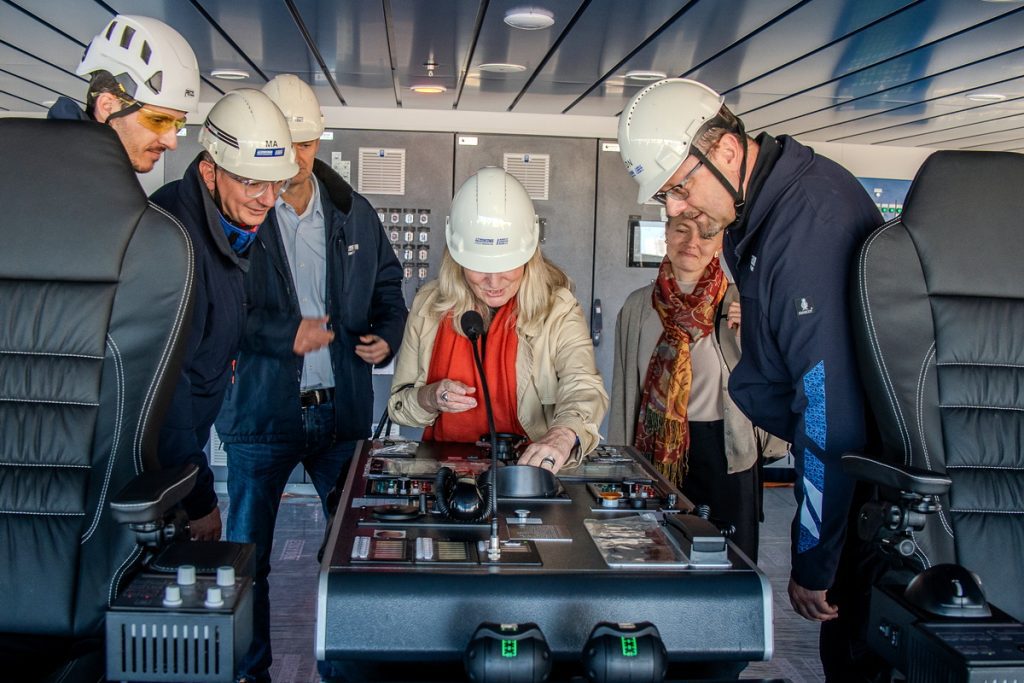
Kerstin Jorna, Director-General of the European Commission’s DG GROW, visited the Remontowa Shiprepair Yard on 15 October. She toured the Ro-Pax ferry Bursztyn Unity, which was built there. She discussed the competitiveness of the European shipbuilding industry, investment funding, pressure from China and the future of European supply chains with the shipyard’s management board.
Kerstin Jorna heads the Directorate-General for the Internal Market, Industry, Entrepreneurship and SMEs, which, among other things, oversees the competitiveness of European industry, its manufacturing capacity, and the EU’s strategic autonomy. Stéphane Séjourné, the European Commission’s Executive Vice-President for Prosperity and Industrial Strategy, oversees it politically.
This senior EC official also helps implement the EU Industrial Maritime Strategy, adopted in March 2026, and supports the development of the EU Industrial Maritime Value Chains Alliance (EMA), launched in September.
This second initiative aims to pool the potential of European shipyards, equipment manufacturers, shipowners, and financial institutions to strengthen the competitiveness of the entire maritime sector.
During her working visit to Remontowa in Gdansk, Kerstin Jorna was accompanied by Katarzyna Kaczkowska, policy officer and economic counsellor at the European Commission’s Representation to Poland.
Both boarded the Bursztyn Unity and familiarised themselves with the programme underway there to build a series of Ro-Pax ferries. The Polish shipyard is one of only two in Europe fulfilling orders from Western shipowners for large vessels of this type with a gross tonnage of over 10,000 tonnes in mid-2026.
According to SHIPPAX, of the 28 such ferries under construction, only two were being built in Europe during this period – the Bursztyn Unity in Poland and one in Italy. The remaining 26 were being constructed in China.
In recent years, large Ro-Pax ferries have also been built by Fincantieri in Palermo (Costanza I di Sicilia) and the Finnish shipyard Rauma Marine Constructions (Spirit of Tasmania IV and Spirit of Tasmania V). The vessels have already been delivered to their owners, and these shipyards are currently busy with other orders.
Remontowa stands out as a large, diversified industrial group combining expertise in ship design, repair, conversion and newbuilding.
‘Made in Europe’ in practice
Representatives of the European Commission could therefore see the completed ferry for themselves, the latest example of the European value chain in action. Over 90 per cent of the Bursztyn Unity’s equipment comes from European suppliers, including key systems – engines and fuel systems (Wärtsilä), propulsion and electrical devices (ABB), and Ro-Ro equipment, including ramps and doors (MacGregor).
Remontowa integrates these advanced technologies to deliver a complete product designed to serve European ferry routes. Ordering such a vessel therefore means work not only for the shipyard, but also for the entire network of manufacturers, designers and equipment suppliers.
– It is not enough to support individual companies; we must look at the entire supply chain – emphasised Kerstin Jorna.
She added that pandemic experiences had already highlighted how much the European economy depends on access to key components and technologies, and how heavily it relies on supplies from outside the continent, including the Far East.
Hence the concept of industrial alliances, which bring together manufacturers, customers, and financial institutions; the most recent example is the EMA.
Support shipowners so that they place orders in Europe
During a discussion with Michał Habina, the Chief Executive Officer, and Bartosz Znyk, the Chief Project Officer at Remontowa’s board, much attention was paid to the growing competition from Chinese shipyards.
– We can talk about technologies, our production methods and capabilities. But in the end, shipowners ask: how much will we pay? How are we supposed to explain to shareholders that we should order a ship here, when it’s cheaper in China? – said Bartosz Znyk.
According to Remontowa representatives, European industrial policy should not only support manufacturers, but above all fleet owners.
– Shipowners should derive tangible benefits from ordering ships from European shipyards. Financial benefits – argued Michał Habina.
– We are already working on this – assured Kerstin Jorna.
One possible instrument could be funds from the EU Emissions Trading Scheme (EU ETS). The EU’s industrial strategy for the maritime sector, adopted in March this year, encourages Member States to allocate part of the ETS revenue to decarbonising shipping.
The EC is also considering a mechanism to directly support shipowners investing in sustainable fuels and clean propulsion technologies, along with preferential treatment for European industry.
During the meeting, Michał Habina highlighted the possibility of linking ETS charges to incentives for ordering vessels or modernising them at European shipyards. Such measures could support not only shipowners but also the entire European supply chain.
Time is money
Financing capital-intensive shipbuilding projects remains a significant barrier. High borrowing costs, lengthy administrative procedures, and frequently delayed payments burden both contractors and shipowners.
The DG GROW Director-General highlighted the role of European instruments, including InvestEU, in mitigating investment risk, as well as cooperation with banks such as BGK. As she explained, EU mechanisms should assume some of the risk that commercial banks are unwilling to bear alone.
Bartosz Znyk, however, pointed out that a financial instrument alone does not solve the problem.
– Timing is crucial. When we run such a complex project, we have to pay our suppliers on an ongoing basis – he emphasised.
From the shipbuilding industry’s perspective, competitiveness depends not only on capital availability, but also on its cost, the timing of its release, and the smooth flow of funding aligned with milestone achievement.
Refits rather than newbuildings?
A separate topic was converting existing vessels as an alternative to building new ones.
– Rather than scrapping them prematurely, many older ships can be converted and adapted to new standards, including environmental ones – argued Michał Habina, pointing to the costs of materials and energy required to build a new vessel.
– I completely agree – replied Kerstin Jorna.
Furthermore, refits align with the EU’s circular economy concept. They can extend a vessel’s life cycle, reduce demand for new materials, and lower capital expenditure, particularly when the vessel being modernised still has many years of service ahead. However, the final environmental impact depends on the conversion’s scope and the vessel’s subsequent use.
Remontowa representatives cited two Ro-Pax ferries (Spirit of British Columbia and Spirit of Vancouver Island) converted here for the Canadian operator BC Ferries as an example, including fitting the new dual-fuel propulsion system powered by LNG. The second shipyard in the Remontowa Holding group – Remontowa Shipbuilding – has built four Salish-class ferries for this operator.
Safety comes at a price
The discussion also touched on how increasingly stringent technical requirements affect shipbuilding costs and environmental footprints.
One example is the ‘Safe Return to Port’ requirements, introduced by the IMO under the SOLAS Convention, which mandate the use of redundant systems on large passenger ships.
– On the Bursztyn Unity, we have over 800 kilometres of cables! This is due to these regulations. Without such requirements, around 250–300 km would ‘suffice’ – said Bartosz Znyk, comparing this figure with vessels not subject to the SRtP requirements.
Producing, transporting, and installing additional materials and equipment on board a ship increases energy consumption, costs, and emissions. Shipyard representatives argued that when assessing a ship’s environmental impact, the entire life cycle should be considered, not just emissions during operation.
Michał Habina also pointed to the possibility of using alternative technical solutions that enhance navigation safety whilst requiring fewer materials.
The discussion highlighted the need to seek solutions that ensure the required level of safety whilst keeping economic and environmental costs reasonable. In a broader context, high energy costs and regulatory burdens, which affect European industry’s competitiveness, are also significant factors.
Will Canada return to Europe?
The Polish shipyard’s experience working with BC Ferries also caught the attention of the Director-General of DG GROW amid the European Commission’s ongoing discussions on developing strategic supply chains with Canada.
– We are currently discussing with the Canadians supply chains in which we can cooperate – she said, pointing, amongst other things, to raw materials, batteries and industrial technologies. She also included ferries amongst the potential areas of cooperation.
Meanwhile, in June 2025, BC Ferries signed a contract with the Chinese shipyard China Merchants Industry Weihai to build four large ferries. This is a telling example of the competitive pressure European manufacturers face, even those with experience working with international shipping companies.
First-hand information
These were not the only topics discussed during the more than two-hour visit to Remontowa Shiprepair Yard. The meeting demonstrated just how important it is, when shaping European industrial policy, to gain first-hand insight into the experiences of large companies undertaking complex manufacturing projects.
Although Kerstin Jorna is not a „pure” politician (as is her boss, Commissioner Stéphane Séjourné), she does have a significant influence on the development of solutions which subsequently form part of the EC’s policy.
The impressions gained from this visit, along with the observations and suggestions shared during the discussion, will certainly help her work to strengthen the competitiveness of Europe’s shipbuilding industry.