
Port of Gdańsk looks across the Atlantic as Poland-US trade gathers pace
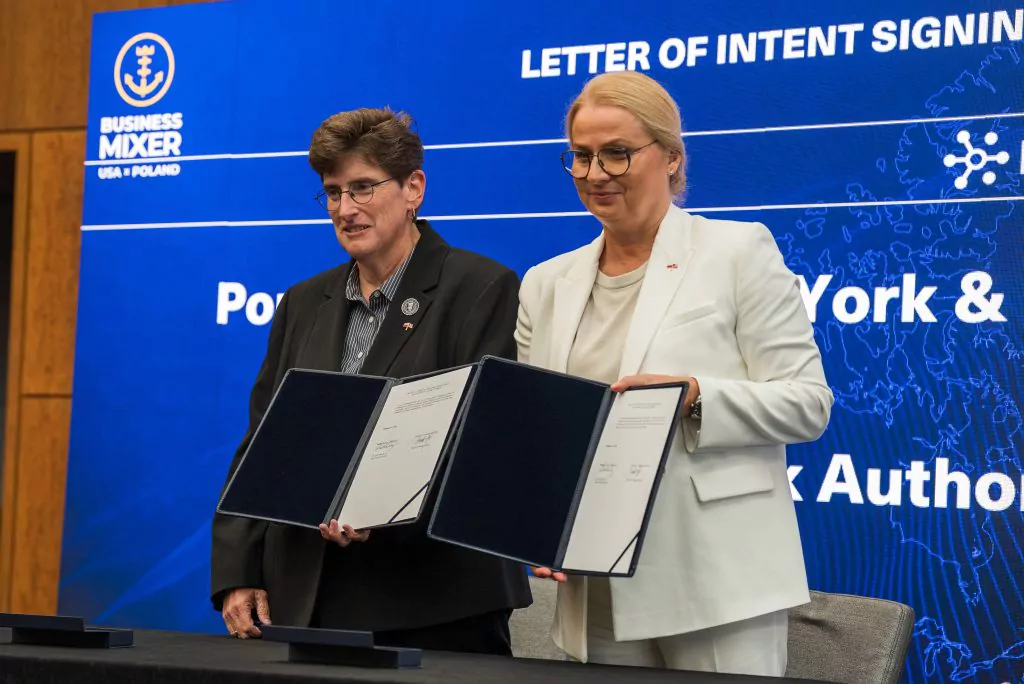
The Port of Gdańsk is seeking a stronger role in trade between Poland and the United States, positioning itself as a gateway not only to the Polish market but also to Central and Eastern Europe. Closer cooperation with the Port Authority of New York and New Jersey and discussions on a potential direct maritime service between Poland and the US were among the key topics of the latest Port of Gdańsk Business Mixer held in the United States.
Trade between Poland and the United States has been expanding, creating new opportunities for ports, shipping companies and logistics operators. According to figures presented during the event, containerised trade between the two countries reached nearly 169,000 TEU in 2025, almost 20 per cent more than a year earlier.
At the same time, a considerable share of cargo moving between Poland and the US continues to be routed through major Western European ports. Gdańsk wants to capture a larger part of these flows directly.
The fifth edition of the Port of Gdańsk Business Mixer brought together representatives of ports, logistics companies, shipping businesses, public administration and other industries from both sides of the Atlantic.
Gdańsk and New York-New Jersey strengthen cooperation
One of the most significant outcomes of the event was the signing of a Letter of Intent between the Port of Gdańsk Authority and the Port Authority of New York and New Jersey.
The agreement is intended to provide a framework for closer cooperation between the two ports, including the development of trade relations, transport connections, exchange of expertise and identification of new business opportunities.
For Gdańsk, the partnership is also part of a broader strategy aimed at positioning the port as an entry point to a market extending well beyond Poland.
Thanks to its connections with Central European countries, the port sees an opportunity to serve a consumer market estimated at around 100 million people, including Poland, Czechia, Slovakia, Hungary, Ukraine and the wider Baltic region.
The US side is also looking at developments in Central and Eastern Europe. American importers are increasingly interested in diversifying supply chains and reducing dependence on Asian sources, which could create additional opportunities for European suppliers and logistics hubs.
Direct US-Gdańsk service could shorten transit times
A major subject of the discussions was the possibility of establishing a direct maritime connection between Poland and the United States.
Today, the lack of such a service means that some cargo has to be transhipped at Western European ports or moved through more complicated logistics chains. Industry representatives taking part in the Business Mixer indicated that this may extend overall transit times by as much as seven to ten days.
For many shippers, particularly those operating time-sensitive supply chains, transit time can be as important as the freight rate itself.
The Port of Gdańsk argues that its infrastructure already provides the capacity required to handle large ocean-going vessels and growing volumes of international cargo.
The expansion of Baltic Hub is an important part of this equation. The commissioning of the T3 terminal has significantly increased container handling capacity in Gdańsk, strengthening the port’s position as one of the main container gateways in the Baltic Sea region.
Major international companies are already using logistics services provided through Gdańsk, while further growth in Poland and neighbouring Central European economies could generate additional cargo volumes.
Energy investments to generate new cargo
The potential for transatlantic cooperation is not limited to containers.
Poland’s major energy and infrastructure programmes are expected to generate demand for project cargo, heavy-lift transport and specialised logistics services.
Among the projects likely to influence future cargo flows are the development of offshore wind energy, expansion of energy infrastructure and construction of Poland’s first nuclear power plant in Pomerania.
The nuclear project has a particularly strong US dimension. The plant is to use technology supplied by Westinghouse, while Bechtel is involved on the engineering and construction side.
Such investments require the transportation of large and often oversized components. Ports therefore need not only suitable quays and lifting capabilities, but also road and rail infrastructure capable of moving abnormal loads further inland.
The Port of Gdańsk already has experience in handling complex project cargo. This could become increasingly important as Poland’s energy transformation accelerates.
Transatlantic trade goes beyond containers
Bulk and break-bulk shipping also formed part of the discussions in the United States.
Polsteam, through its US operations, highlighted the role of its LakerMax vessels in transporting steel and specialised cargoes between Europe and North America. The development of alternative marine fuels was also raised as an important challenge for both ports and shipowners.
While shipping companies can introduce vessels capable of operating on fuels such as green methanol, corresponding bunkering infrastructure must be available in ports if such technologies are to be deployed on a larger scale.
This creates another area where cooperation and exchange of experience between European and American ports could become increasingly valuable.
Gdańsk wants to be a gateway to Central Europe
The wider economic figures provide a strong backdrop for the port’s ambitions. Polish-American bilateral trade reached approximately USD 33 billion in 2025, including around USD 13 billion in Polish exports to the United States.
Trade between the two countries is also becoming increasingly diversified, covering industrial products, pharmaceuticals, advanced technologies, food products, aerospace and energy.
For the Port of Gdańsk, the challenge is to translate this growing economic relationship into higher volumes of cargo handled directly through Polish terminals.
The port is simultaneously planning its long-term development. Work is underway on a Master Plan and Development Strategy extending to 2050, with maritime and land access infrastructure expected to play a central role.
Security is another increasingly important factor. Located on NATO’s eastern flank, the Port of Gdańsk is developing surveillance capabilities, anti-drone solutions and systems intended to maintain operational continuity in situations involving GPS interference or disruption of satellite signals.
The latest US mission shows that Gdańsk’s ambitions extend beyond increasing cargo throughput. The port wants to establish itself as a logistics and business platform connecting American companies with Poland and the wider Central and Eastern European market.
Whether this will eventually result in a regular direct shipping service between the United States and Gdańsk remains to be seen. However, growing bilateral trade, new terminal capacity and closer cooperation with the Port Authority of New York and New Jersey provide a stronger foundation for such a connection than in previous years.
Source: Port of Gdańsk / Poland at Sea

