
Baltic Power Offshore Wind Farm Generates Increasing Amounts of Energy
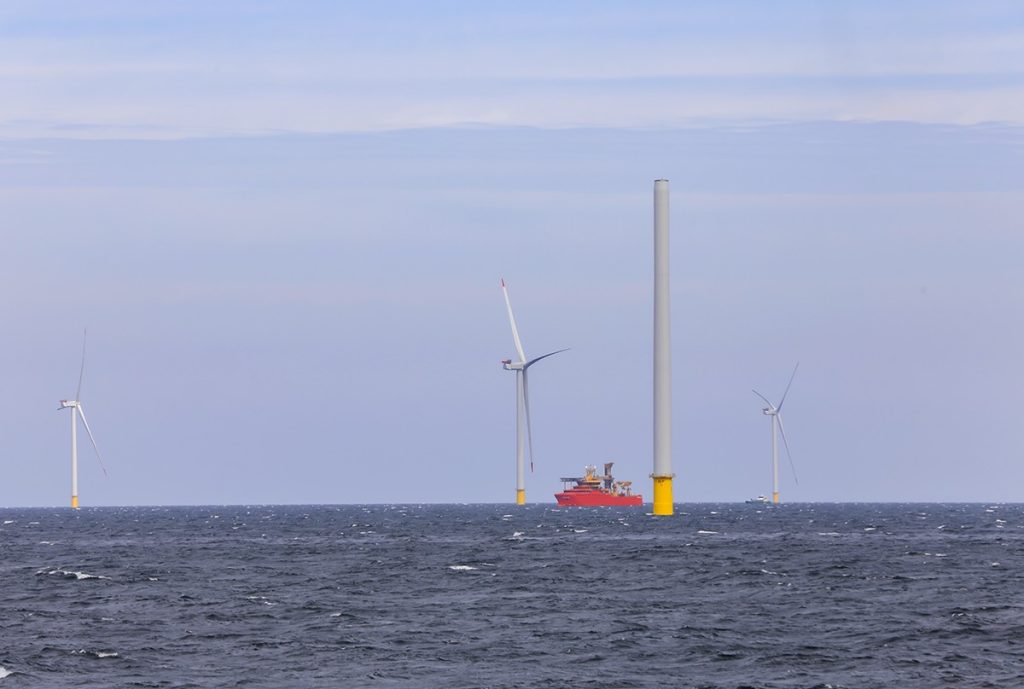
The Baltic Power offshore wind farm is steadily increasing electricity generation as more turbines are commissioned and connected to Poland’s national power grid.
The project, jointly developed by ORLEN and Northland Power, delivered its first electricity to the Polish grid in July, marking the “First Power” milestone. Since then, additional turbines have gradually been brought online as the 1.2 GW offshore wind farm moves closer to full operation.
“We currently have 67 fully assembled turbines installed, along with nine towers. Several turbines are already generating electricity and have successfully completed testing. There is not much left to do before the turbine installation phase is completed,” said Małgorzata Żurawińska, Wind Turbine Technical Manager at Baltic Power.
Baltic Power is being equipped with some of the largest wind turbines currently available on the European market. Each 15 MW turbine reaches a height of around 260 metres, making it comparable to – or even taller than – Warsaw’s Palace of Culture and Science.
The scale of the components requires the use of some of the largest specialist installation vessels currently operating in the offshore wind sector.
The turbines are being installed by Wind Mover, a jack-up installation vessel operated by Cadeler. The vessel is equipped with a 2,600-tonne main crane and a DP2 dynamic positioning system and is capable of operating in water depths of up to 65 metres.
Hundreds of people involved offshore
Installing a wind farm of this scale requires the coordination of numerous companies, vessels and offshore personnel. At peak times, around 500 people may be working within the wind farm area.
Safety therefore remains one of the key priorities throughout the installation campaign. Since the project began in January 2024, nearly 5,000 offshore workers have undergone training. They include crews from more than 90 vessels, ranging from small crew transfer vessels to major installation units such as Wind Mover.
According to Tomasz Cendrowski, HSE Manager at Baltic Power, personnel training is particularly important due to the wide range of hazards associated with offshore operations, including working at height and handling heavy mechanical equipment.
Workers must also be prepared to provide immediate first aid in an emergency. Each turbine is equipped with emergency and medical equipment, including stretchers, first-aid kits and automated external defibrillators (AEDs). Offshore personnel are also trained in turbine evacuation procedures.
Weather conditions are another major factor affecting offshore operations. Wind, waves and low water temperatures can significantly influence both safety and the installation schedule.
“When the water temperature drops below 12 degrees Celsius, personnel are required to wear special survival suits designed to maintain a safe body temperature if someone falls overboard,” Cendrowski explained.
Weather forecasts are closely monitored and play a crucial role in planning day-to-day activities offshore.
How are the turbines installed?
The main components of each wind turbine – the tower, nacelle and three blades – are manufactured at different production facilities before being transported to the installation port.
At the port, individual tower sections are assembled into complete towers, while nacelles and other components undergo final preparation and testing.
The components are then loaded onto the installation vessel, which can carry up to four complete turbine sets at a time – four towers, four nacelles and 12 blades.
After reaching the designated turbine location, the jack-up vessel lowers its legs to the seabed and raises its hull above the water surface, creating a stable platform for heavy-lift operations.
Installation begins with the tower, followed by the nacelle and then the three blades, which are installed individually.
Once assembled, each turbine enters the “cold commissioning” stage, during which mechanical work and cable connections are completed. This is followed by “hot commissioning”, when the turbine is energised and ultimately begins generating electricity.
The turbine installation campaign at Baltic Power is expected to be completed later this year.
Poland’s first offshore wind farm
Baltic Power, developed jointly by ORLEN and Northland Power, is set to become Poland’s first offshore wind farm to deliver electricity generated in the Baltic Sea on a commercial scale.
With an installed capacity of approximately 1.2 GW, the wind farm is expected to generate around 4 TWh of electricity annually – enough to supply more than 1.5 million households.
Once fully operational, Baltic Power is expected to meet approximately 3% of Poland’s current electricity demand.
The wind farm covers an area of around 130 square kilometres – roughly equivalent to the size of the city of Gdynia – and is located approximately 23 kilometres off the Polish coast, near Łeba and Choczewo.
Baltic Power will comprise 76 Vestas V236-15 MW wind turbines. With a capacity of 15 MW each, they rank among the largest and most advanced turbines currently being deployed in European offshore wind projects.
According to Baltic Power, a single turbine operating for just one minute can generate enough electricity to power an electric city bus for approximately 100 kilometres.
Electricity generated by the turbines is collected by two offshore substations located around 20 kilometres from the coast. Four export cables connect the substations with an onshore substation in the Choczewo municipality, from where the electricity is transmitted to Poland’s national power grid.
Łeba to serve as Baltic Power’s operational hub
Baltic Power’s operations and maintenance base is located in Łeba. The facility will serve as the wind farm’s home port and maintenance centre for approximately 30 years and is expected to employ around 70 technicians.
Commissioned in April 2025, the base is already supporting the offshore installation campaign.
It also houses the Baltic Power Offshore Coordination Centre, which operates around the clock, monitoring maritime traffic in and around the wind farm as well as the activities of vessels involved in the installation campaign.
Source: PortalMorski.pl
Photos: Sławomir Lewandowski / PortalMorski.pl


